

How to Become a Registered Nurse (RN) in India?

Registered Nurses (RNs) are vital pillars of the healthcare system, providing compassionate, evidence-based care to patients while supporting doctors and medical teams in delivering effective treatment.
With the growing demand for qualified nurses in India, pursuing a career as an RN offers excellent job stability, career growth, and global opportunities.
To become a Registered Nurse in India, you need the right education, skills, and registration with the Indian Nursing Council (INC). This step-by-step guide will explain the eligibility, nursing courses, licensing process, and key competencies required to start your rewarding nursing career.
Interested in Nursing? Take the first step right away!
Registered Nurse (RN) - A Brief Overview
A Registered Nurse (RN) is a licensed healthcare professional responsible for delivering direct patient care and assisting doctors in various medical procedures. RNs play a crucial role in maintaining patient health, ensuring accurate treatment, and promoting recovery. They work in diverse healthcare settings such as hospitals, clinics, nursing homes, and home care facilities, providing care that combines both technical skill and compassion. Their duties range from administering medications to monitoring vital signs and maintaining accurate patient records.
Roles & Responsibilities of Registered Nurse
Registered Nurses perform a wide range of tasks that ensure patients receive safe, effective, and compassionate care. Here are the key roles and responsibilities:
- Assess and monitor patients’ health: Checking vital signs, conducting physical exams, and maintaining accurate medical records.
- Develop and implement nursing care plans: Administering prescribed medications, treatments, and wound care.
- Collaborate with healthcare teams: Coordinating with doctors, pharmacists, and social workers to deliver effective patient care.
- Advocate for patients and families: Ensuring quality treatment, safety, and emotional support throughout the care journey.
- Educate patients and caregivers: Guiding on health maintenance, recovery plans, and disease prevention strategies.
- Adhere to ethical, professional, and legal standards: Maintaining quality and accountability in all aspects of nursing practice.
Learn more: Roles and Responsibilities of Nurse
Step by Step Process to Become Registered Nurse (RN) in India
Here are the step by step process to become a registered nurse in India:
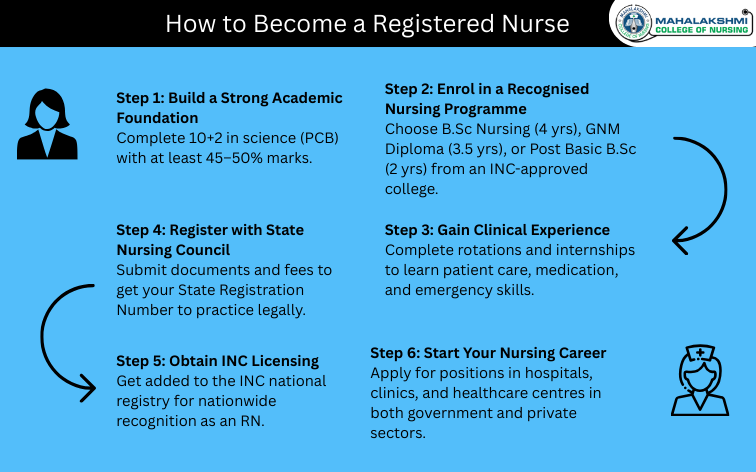
Step 1: Build a Strong Academic Foundation
Your journey to becoming a registered nurse starts with completing higher secondary education (10+2) in the science stream, focusing on Physics, Chemistry, and Biology. Aim for at least 45–50% marks, as most nursing colleges use this as a minimum eligibility criterion. A solid foundation in science subjects helps you understand core nursing concepts and prepares you for entrance exams.
Step 2: Enrol in a Recognised Nursing Programme
After Class 12, choose a nursing qualification that aligns with your goals:
- B.Sc Nursing (4 years): Comprehensive professional degree for those aiming to become RNs.
- GNM (General Nursing and Midwifery) Diploma (3.5 years): Focuses on practical nursing and midwifery training.
- Post Basic B.Sc Nursing (2 years): For candidates who already hold a GNM qualification.
Always ensure your chosen institution is approved by the Indian Nursing Council (INC) and affiliated with a recognised university.
Step 3: Gain Hands-On Clinical Experience
During your nursing programme, you’ll participate in clinical rotations and internships at hospitals or community health centres. These practical sessions are essential for developing real-world nursing skills such as patient assessment, medication administration, emergency response, and wound care. Completion of both theory and practical exams is mandatory to qualify for registration.
At Mahalakshmi College of Nursing, our students gain hands-on clinical training at Rathna Hospital, Trichy, a NABH-accredited hospital - it helps them develop real-world nursing skills.
Step 4: Apply for Registration with the State Nursing Council
Once your course is complete, you must register with your State Nursing Council to legally work as a nurse. You’ll need to submit:
- Degree or diploma certificates
- Internship completion proof
- Academic transcripts
- Identity and address verification documents
- Passport-size photographs and applicable fees
Upon approval, you’ll receive your State Nursing Registration Number, which officially recognizes you as a Registered Nurse within that state.
Step 5: Obtain Official Licensing Through the INC
After registering at the state level, your details are added to the Indian Nursing Council’s (INC) central registry. This step formalizes your professional status nationwide and allows you to practice nursing legally across India. Keep your registration active and renewed as per the guidelines of your State Nursing Council.
Step 6: Start Your Nursing Career
Begin applying for Registered Nurse positions in hospitals, clinics, community health centres, and home healthcare organizations. You can explore various career opportunities in both government and private sectors.
What's Next?
After becoming a Registered Nurse (RN) in India, the next step is to grow your expertise and expand your career options in the healthcare field. Nursing offers a wide range of pathways for professional advancement, higher education, and international exposure.
- Pursue Higher Studies: Enroll in advanced programs like M.Sc. Nursing, Postgraduate Diplomas, or Doctor of Philosophy (PhD) in Nursing to move into leadership, teaching, or research roles.
- Specialize in a Nursing Field: Choose a specialization such as Critical Care, Pediatric Nursing, Operation Theatre Nursing, Community Health, or Psychiatric Nursing based on your interests and experience.
- Gain Global Opportunities: Apply for international licensure exams such as NCLEX (USA), HAAD (UAE), or IELTS/OET (UK, Australia, Canada) to work abroad in high-demand healthcare systems.
- Join Professional Nursing Associations: Become a member of organizations like the Trained Nurses’ Association of India (TNAI) or State Nursing Councils to stay updated on nursing laws, workshops, and conferences.
- Engage in Continuous Learning: Participate in Continuing Nursing Education (CNE) programmes to update your clinical knowledge and maintain an active registration.
With the growing need for skilled healthcare professionals in India and globally, a career in nursing offers long-term stability, personal satisfaction, and a chance to make a real difference in people’s lives.
Start Your Nursing Journey at the Best Nursing College in Trichy, Tamilnadu
Thinking of becoming a nurse? Take a first step by enrolling B.Sc Nursing at Mahalakshmi College of Nursing. Our college is affiliated with Tamil Nadu Dr. M.G.R. Medical University and recognized by the Indian Nursing Council. Our B.Sc Nursing program offers modern classrooms, advanced labs, and hands-on clinical training at NABH-accredited Rathna Hospital, giving you the skills and confidence to excel in healthcare.
The Right Time is Now!Join us today and shape your future as a skilled, compassionate nurse!
FAQs
To become an RN in India, you need to complete higher secondary education (10+2) in the science stream with Physics, Chemistry, and Biology, followed by a recognized nursing program such as B.Sc Nursing, GNM Diploma, or Post-Basic B.Sc Nursing.
Registered Nurses provide direct patient care, assist doctors and medical teams, monitor vital signs, administer medications, maintain patient records, and educate patients and families on health and recovery.
Students can choose between B.Sc Nursing (4 years), GNM Diploma (3.5 years), or Post-Basic B.Sc Nursing (2 years) depending on their educational background and career goals.
After completing a nursing program, you must register with your State Nursing Council, submit educational and identity documents, and obtain a State Registration Number, which legally allows you to practice as a nurse.
Once registered at the state level, your details are added to the INC central registry, granting nationwide recognition and authorization to practice as a Registered Nurse across India.
RNs can work in hospitals, clinics, nursing homes, and community healthcare settings. They can also pursue higher studies (M.Sc Nursing, PG Diplomas), specialize in areas like Critical Care or Pediatrics, or explore global opportunities through international licensing exams.
Mahalakshmi College of Nursing is affiliated with Tamil Nadu Dr. M.G.R. Medical University and recognized by the Indian Nursing Council, offering modern classrooms, advanced labs, and hands-on clinical training at NABH-accredited Rathna Hospital to prepare students for a successful nursing career.